The Gateway Corridor
The same 17-row governance ledger, rendered as a corridor instead of a table — every real call converges through one governed checkpoint on its way to a real backend.
What you're looking at
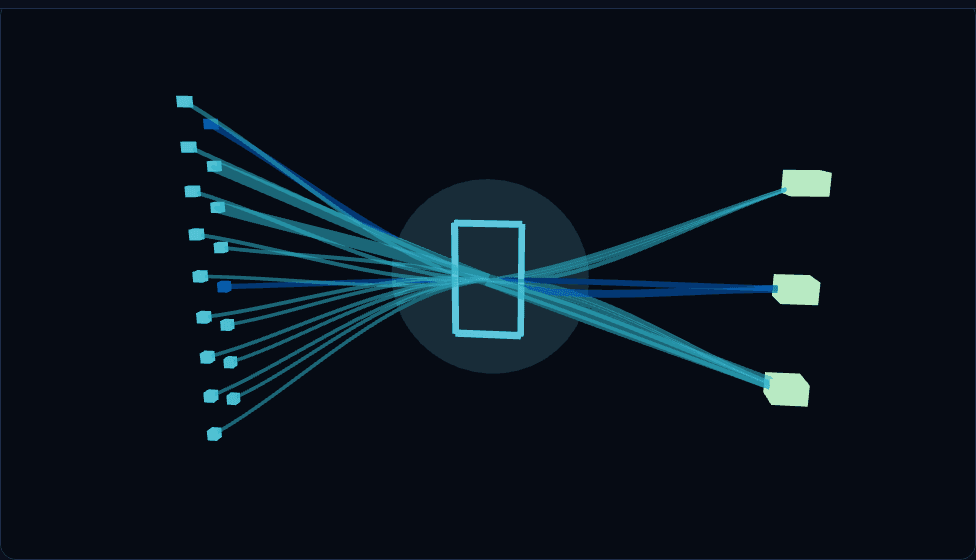
A GPU particle field on the left renders the same 17 real rows already live at /demos/governance-ledger, converging through a single glass gate and fanning out to three real backend destinations on the right. Every ribbon is one real call from Tioga's own AI routing gateway, captured Jul 17–25, 2026 — nothing here was written for this page. Ribbon width is each row's real token count, not a decoration.
The gate is the governance layer made physical: every ribbon — free-pool and paid alike — passes through the same budget-reservation checkpoint against the real $30.00 / 30-day cap. That's a more honest picture than making free-tier calls visibly dodge it: they're checked the same as any other call, they just settle at $0. There is deliberately no approval-gate mechanic layered on top — the ledger has no write/read-path field and no approval events in these 17 rows, so animating one none of them ever passed through would contradict the whole point of this page: flip to the table and verify every ribbon.
Honesty note: this is a dated excerpt, refreshed periodically — not a live-refreshing feed. Same caveat as the table view it's built from.
The scene
The ledger field
17 real rows, rasterized into a GPU particle field — the same table as /demos/governance-ledger, made of light instead of HTML. Ribbon width is each row's real token count — wider ribbons carried more tokens, not a decoration. Press Replay to watch each row's own particles detach and travel the real, compressed Jul 17–25 timeline.
The gate
Every ribbon passes through the same checkpoint — the budget reservation against the real $30.00 / 30-day cap. Spend sits at $0.000753. 15 of 17 calls are free-pool; 12 of those (71%) settle at exactly $0. 2 paid calls don't. Real glass (refraction, not a flat glow) — the ribbons visibly bend passing through it.
Pool terminals
3 backend pools light up as calls arrive — requested→served is real: e.g. glm-flash served by qwen/qwen3-8b.
Same data, table view
Every row in the scene above, as the same HTML table it's built from.
How this was built
React Three Fiber v9 (React 19 / Next 15) over the same typed lib/governance-ledger.ts module the table page imports, so the two views can never drift. The 17-row table on the left is a real GPU particle field — the same rows rasterized to a texture and simulated with a compute shader (GPUComputationRenderer), not an image or a decoration. At the resolution this renders at, individual characters aren't crisply legible — the field's shape and internal texture are genuinely built from the real row text, it just doesn't read as typography from a normal viewing distance. Every ribbon and pool node is real WebGL, generated from that data — ribbon width is each row's real token count, ribbon color is its real pool. The gate is real glass (drei's MeshTransmissionMaterial) — the ribbons visibly refract passing through it, not a flat glow standing in for one. The hero image above is a captured still of this actual scene — not an AI-generated mockup. No 3D text: every label on this page is DOM, not canvas. The scene rests at its completed state by default rather than looping continuously — Replay plays the real, compressed timeline once, using the actual gaps between these calls' timestamps, not an even cadence: each row's own particles detach from the field and stream the corridor alongside its pulse, flashing green for the moment it actually crosses the gate. An optional sound toggle (off by default) plays a short synthesized tick per crossing, pitched by that row's real token count — 17 real rows, 17 real notes, never autoplayed.
Want this pattern built into your systems?
A discovery call gets you a scoped assessment from the person who builds these governed write-paths — not a form, a conversation.
Book a discovery call